Cats
How Often Should You Change Cat Litter? A Real Schedule
Scoop twice a day, strip the tray weekly or fortnightly depending on litter type. If it smells, the schedule isn't your problem.
7 min read
The one that never starts to smell.
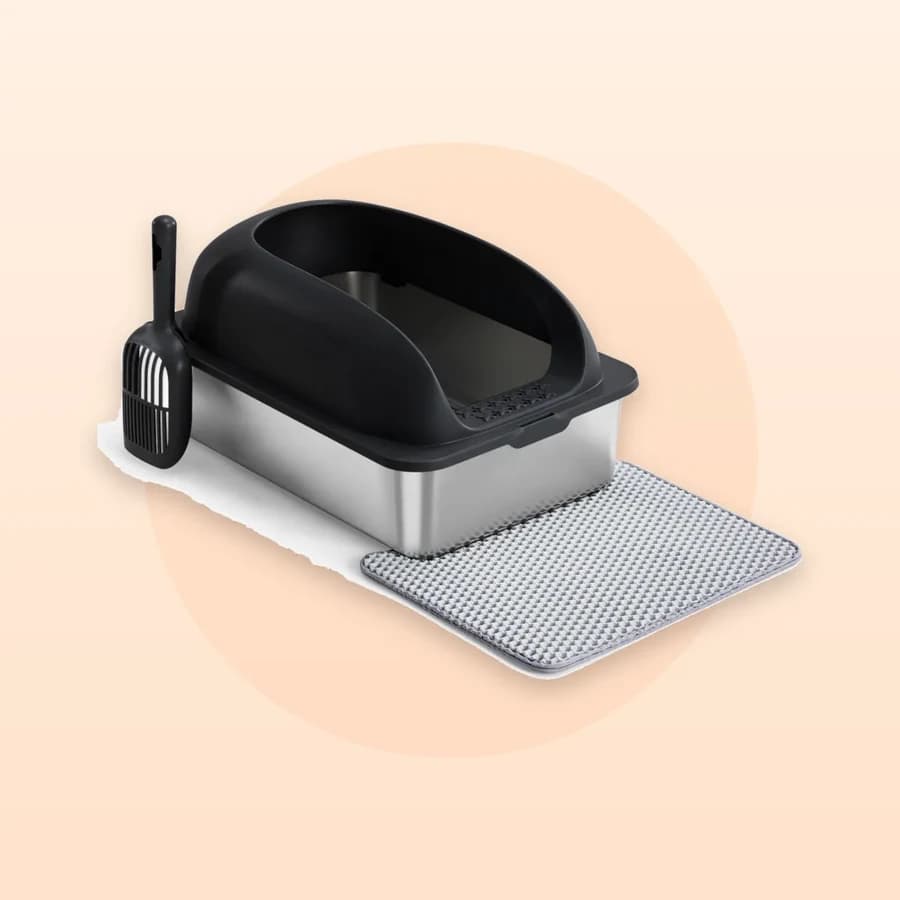
Plastic trays smell because claws score the surface and urine soaks into the scratches. Steel does not scratch, so there is nowhere for it to soak into and nothing to develop.
Taxes calculated at checkout
Colour: Black
Why you'll love it
Every scoop leaves fine scratches in a plastic tray, and urine soaks into them. That is why an old tray smells within minutes of cleaning. Steel has no pores and does not scratch, so the smell has nowhere to live.
Most litter on the floor is kicked over the side by a cat digging. 30cm walls with a curved lip keep it in, and the mat catches what comes out on their paws.
A cat should be able to turn a full circle and dig without touching the sides. At 60 x 40cm this suits large breeds and multi-cat homes, where a standard tray is the reason someone starts going on the carpet.
Good fit if
Look elsewhere if
A cat digs before and after using a tray, and its claws score the plastic every time. Those scratches are microscopic at first and they accumulate over months, and urine works into them. Once it has, washing the surface does not reach it, and the tray smells even when it is objectively clean.
That is the point at which most owners buy a new tray, and the cycle restarts. It also matters to the cat before it matters to you, since a cat's sense of smell is far better than ours. A tray that smells faintly to you may already be one your cat is reluctant to use, and reluctance is how tray avoidance starts.
Stainless steel is hard enough that claws do not mark it and non-porous, so nothing soaks in. The surface you wash is the whole surface, and it stays that way for the life of the tray. Practically, this means one tray rather than a plastic one replaced every year or two, which is most of the cost argument.
The high plastic surround does a different job. Cats that dig enthusiastically spray litter well past the edge of a low tray, and thirty centimetres of wall contains almost all of it. The combination is a tray that neither smells nor distributes its contents across the floor, which are the two complaints people have about litter trays.
At sixty by forty centimetres this is larger than most trays sold, which is a feature. The guidance is roughly one and a half times the cat's body length from nose to tail base, and most commercial trays fall short of that for an average adult cat, let alone a large breed.
Fill it three to four centimetres deep. That is enough to dig properly and shallow enough that the cat is not wading, and it is the depth most cats prefer when given a choice. Deeper is not better: it wastes litter, it makes scooping harder, and plenty of cats actively dislike it.
In the box
How it works
Shop by pet or category to find exactly what your cat or dog needs, no wading through thousands of listings.
Check out securely with card, PayPal or one-tap Apple Pay & Google Pay. Free delivery over $59.
Fast, tracked dispatch straight to your door, and a happier pet before you know it.
The details
Scoop daily, without exception. That is the single most important thing, and it matters more than the tray or the litter. Cats are fastidious about where they toilet, and a tray with yesterday's waste in it is one many cats will decline in favour of a rug.
Change the litter completely every two to three weeks with clumping litter, or weekly with non-clumping, and wash the tray at the same time. Warm water and unscented washing-up liquid is right; the steel tray is dishwasher safe if it fits. Avoid anything strongly perfumed, and never use a product containing ammonia, since ammonia is a component of urine and a cat reads it as another cat having already claimed the spot.
Good questions
It is generous rather than excessive. A cat should turn a full circle without touching the sides, and most trays sold as large do not allow that. If you are short on floor space, measure 60 x 40cm first.
Litter sits several centimetres deep, so the cat never touches the metal. Scooping against steel is slightly louder than plastic, which is the one real trade-off.
No. Most trays sold are too small rather than the other way round, and the guidance is roughly one and a half times the cat's body length. A larger tray is used more willingly.
It is not noticeably cold once litter is in it, and litter muffles the sound of digging. Cats generally take to it within a day or two if you move the litter across from the old tray.
One per cat plus one spare, in different rooms. Two cats need three trays, and lining several up in one room counts as a single location as far as the cats are concerned.
Last reviewed August 30, 2026
Advice
Scoop twice a day, strip the tray weekly or fortnightly depending on litter type. If it smells, the schedule isn't your problem.
7 min read