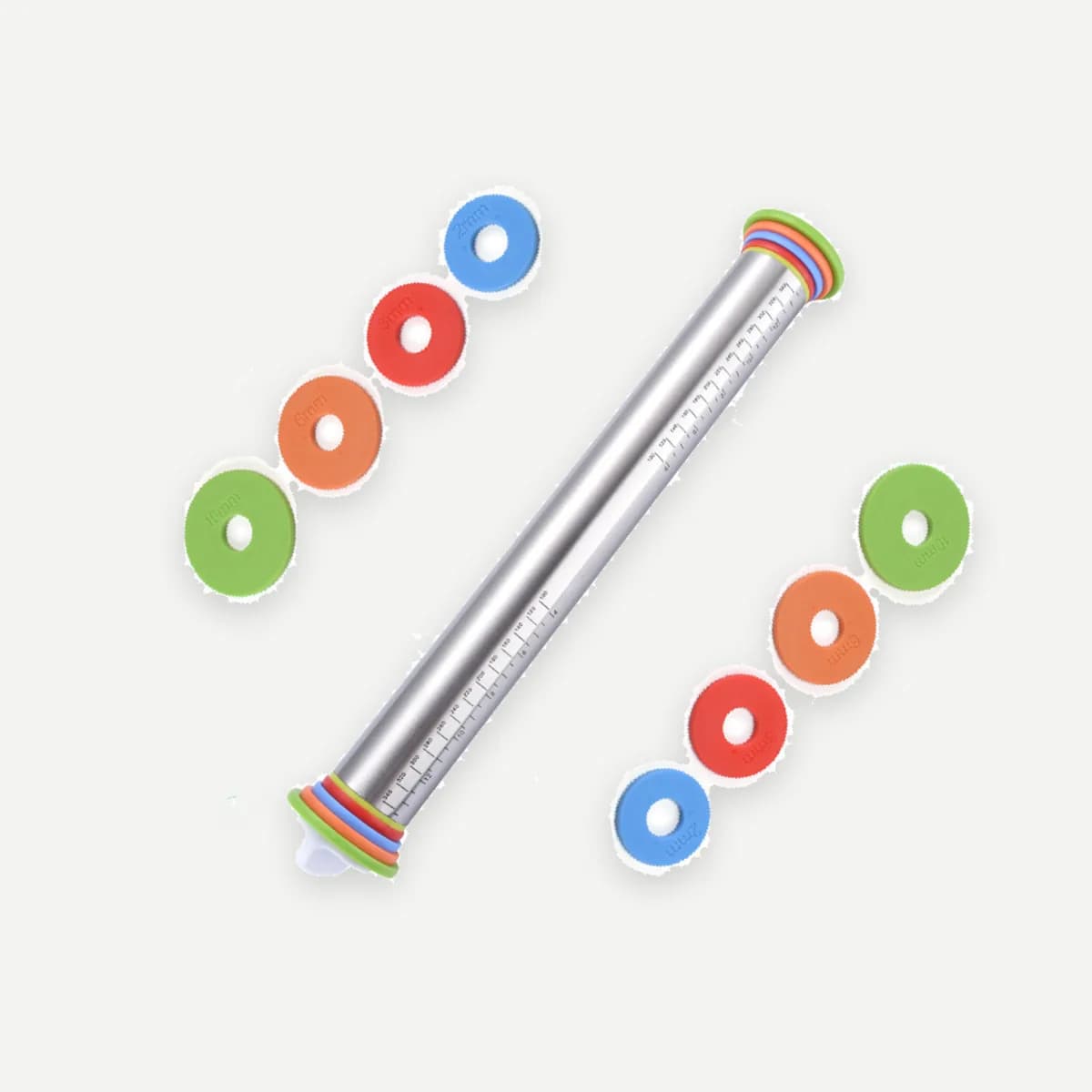
Fit a pair of rings to the ends and roll until they touch the countertop. The dough underneath is then the same thickness all the way across, so biscuits bake evenly and pastry has no thin spot to tear.
1
Free US shippingover $59
30-dayfree returns
Securecheckout
Rings for 2, 3, 6 and 0.4 in (10 mm)
Stainless steel barrel, 1.8 in (4.5 cm) across
Scale printed along the barrel
End caps screw off to change rings
Adjustable Rolling Pin
How to use it
Set the thickness, then roll
01
Pick a pair of rings
Unscrew one end cap, slide a ring of the same size onto each end, and screw the cap back on.
02
Roll until it rides
Roll out from the middle. When both rings touch the countertop, the dough under the barrel is that thickness.
03
Check the width
Read the scale on the barrel to see how wide the sheet is before you cut or lift it.
Close up
How the rings set the depth
123
1
Thickness rings
Four pairs, color coded by depth: green lifts the barrel 0.4 in (10 mm), orange 0.2 in (6 mm), red 0.1 in (3 mm) and blue 0.1 in (2 mm).
2
Printed scale
Marks run along the steel, so you can roll a sheet to the width a recipe or a tin asks for.
3
Screw caps
One at each end. Unscrew a cap to swap rings, and always fit the same size at both ends or the sheet will slope.
Compared
Rings, guide strips or a plain pin?
A plain pin works if you have a good eye. Rings take the guessing out of it and travel with the pin, while loose guide strips have to be laid either side of the dough every time.
Compared
This productAdjustable pin
Plain wooden pin
Pin and guide strips
Sets the thickness
Yes
No
Yes
Thickness choices
2, 3, 6 and 0.4 in (10 mm)
By eye
One per pair of strips
Pieces to keep
Pin and rings
Pin
Pin and strips
Cleaning
Wipe and dry
Wipe, never soak
Wipe each strip
Questions
2 or 0.1 in (3 mm) for pasta sheets, crackers and thin pastry, 0.2 in (6 mm) for biscuits and a tart case, 0.4 in (10 mm) for scones and thick cookies.
Yes. Take the rings off and it works as a plain 17.3 in (44 cm) straight pin for anything where the thickness doesn't matter.
17.3 in (44 cm) from end to end. The steel barrel is 13.8 in (35 cm) long and 1.8 in (4.5 cm) across, so it rolls a sheet up to about 13.8 in (35 cm) wide in one pass.
It needs a light dusting of flour, as wood does. Chilled dough sticks less. For very soft dough, roll it between two sheets of baking paper with the rings still fitted.
Yes. Dust the countertop with icing sugar or cornflour and fit the 2 or 0.1 in (3 mm) rings, which suit covering a cake or cutting shapes.
Reviews
4.6
86 reviews
Sample, not real
Filter
Owen T.
Oct 2, 2026
Sample, not real
Bakewell tart success
Entered a Bakewell tart in the village show and the judge commented on how even the pastry was. Credit to this pin. I used the 3 mm rings, rolled between two sheets of baking paper so nothing stuck, and the case baked evenly instead of being thick on one side like it normally is. Already lent it to my neighbour for her quiche.
Southern style biscuits are what I make most, and I like them close to an inch tall before baking. The thickest ring is 10 mm, which is under half an inch, so for biscuits I still pat the dough out by hand. For sugar cookies and pie crust it's excellent and my rolled cookies have never looked more uniform. Four stars only because it misses the thing I bake most.
He is nine and loves putting the rings on. We roll out biscuit dough together and he reads the scale on the barrel. Lovely activity for a rainy afternoon.
Hosting a christening tea and needed scones, mini quiches and shortbread. Swapped from 10 mm to 3 mm to 6 mm through the day and the pin did all of them. No fiddly ruler, no guessing. By the end I could change rings in the time it took to dust the worktop. Properly handy for something so simple.
Feels well made and the end caps screw on firmly so the rings stay put. Used it for cheese straws and oat biscuits this week, both came out nice and even.