Birds
Bird Cage Size Guide: Minimums by Species
Width beats height, bar spacing is a safety issue rather than a preference, and the 'minimum' on the box is usually a sleeping cage.
7 min read
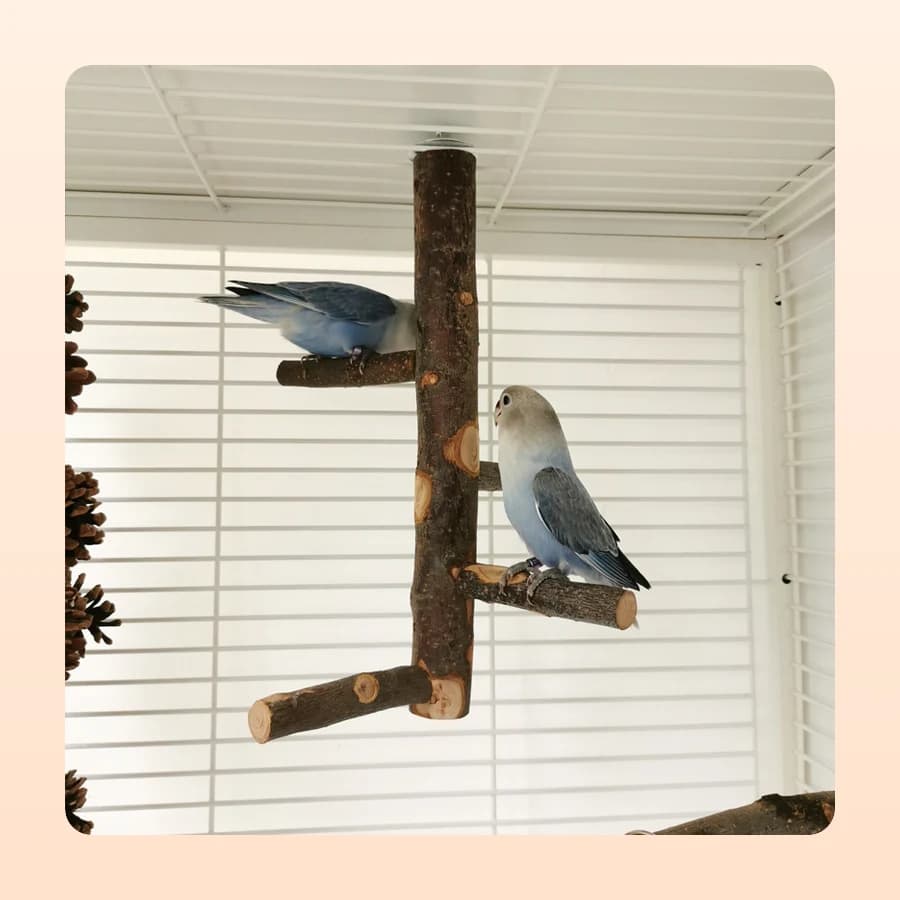
An uneven branch, which is the point.
The uneven thickness is the whole feature. A bird standing on identical dowels holds one grip position all day, and that is what produces pressure sores on the same points.
Taxes calculated at checkout
Design: Plain branch
Why you'll love it
A perch of one diameter holds the foot in exactly the same position all day, every day. That constant pressure on the same points is a well-known route to sore feet in caged birds. A branch varies, so the load moves.
Not all wood is. Apple, pear and willow are safe for birds to chew; cherry, avocado and most stone fruits are not. Buying an untreated branch you know the species of is the whole reason to buy one rather than pick one up outside.
Birds strip bark. That is normal and good for the beak, and it means a wooden perch is a consumable, so expect to replace it when it has been whittled thin.
Good fit if
Look elsewhere if
A perch is correctly sized when the bird's toes wrap around roughly three quarters of it without meeting underneath. Too thin and the foot clenches permanently; too thick and it cannot grip properly. That much is standard advice, and it is only half the picture.
The other half is that no single diameter is right all day. A cage where every perch is the same means the foot holds one identical position for every waking hour, and pressure concentrates on the same points. Over months that produces sore, flattened patches on the underside of the foot.
A real branch tapers, bends and varies in thickness along its length. The bird gets a different grip depending on where it lands, so no single part of the foot takes constant pressure. Bark texture adds grip variation too, which a smooth moulded dowel cannot provide at any diameter.
Apple is one of the woods considered safe for birds, along with willow and several other untreated hardwoods. That matters because birds chew perches, so the wood ends up in them. Never substitute an unidentified branch from the garden, since several common trees are toxic and others carry pesticide residue.
Birds sleep on the highest perch they can reach, so keep that one comfortable and put rougher, more textured perches lower down where they are used during the day. Fit perches at both ends of the cage so there is a genuine flight between them rather than a single hop.
Never position one directly above a food or water dish, and leave clearance behind it so the tail can hang without brushing the bars. A bird that cannot avoid the bars ends up with a worn, ragged tail, and that is a cage layout problem rather than a grooming one.
Adding one is usually better than swapping one out. Three or four perches of different materials and thicknesses gives a bird genuine choice, and the whole benefit comes from that choice rather than from any single perch being correct. Keep the cage middle reasonably clear so there is still room to move between them.
In the box
How it works
Shop by pet or category to find exactly what your cat or dog needs, no wading through thousands of listings.
Check out securely with card, PayPal or one-tap Apple Pay & Google Pay. Free delivery over £45.
Fast, tracked dispatch straight to your door, and a happier pet before you know it.
The details
Bare wood cannot be disinfected the way a moulded plastic perch can, because the porous surface holds whatever soaks into it. Scrape droppings off with a stiff brush, wash with hot water and let it dry completely in sunlight where possible, which does more than most cleaners.
Replace it when it becomes heavily soiled or when chewing has thinned it enough to change the grip. That is not a fault: a chewed perch is a perch doing part of its job, and treating it as a consumable is the right approach for anything a bird works on with its beak.
Good questions
Add it rather than replace everything. A cage wants perches of several diameters at several heights; keeping one dowel and adding a branch gives more variety than swapping like for like.
Not directly above a food or water bowl, for obvious reasons. High in the cage is preferred by most birds, so put the natural branch where they actually want to sit.
Yes, apple is on the standard safe-wood list and the branch is untreated. Stripping bark is normal beak maintenance.
One where the toes wrap about three quarters of the way round without meeting. Budgies suit roughly 12 mm, cockatiels 16 to 20 mm. More important is fitting several different thicknesses rather than one correct size.
Only if you can identify the tree as a safe species and are confident it has never been sprayed. Several common garden trees are toxic to birds, so an unidentified branch is not worth the risk.
No, it is what untreated wood is for. Chewing wears the beak and occupies the bird. Replace it when it thins enough to change the grip.
Last reviewed 30 August 2026
Advice
Width beats height, bar spacing is a safety issue rather than a preference, and the 'minimum' on the box is usually a sleeping cage.
7 min read