The Kindral shop
Aquarium LED Lighting
Aquarium lighting has two jobs, and only one of them is making the tank look good. Plants need enough light for long enough to photosynthesise, and everything in the tank needs a predictable day and night. Get the duration wrong and you grow algae instead of plants.
- Six to eight hours a day for most tanks, on a timer
- More hours grows algae; more intensity grows plants
- Extendable brackets let one unit fit several tank widths
- Accent lighting is decoration and does not replace a main light
2 products

Photoperiod beats intensity
The most useful setting on any aquarium light is the timer. Six to eight hours a day suits most freshwater tanks, and a planted tank rarely benefits from more than eight. Leaving a light on all evening because the tank looks good is the single most reliable way to produce a green film on the glass within a fortnight.
If plants are struggling, the answer is usually more intensity rather than more hours. Algae outcompetes plants when light is plentiful but something else is limiting, so a long weak photoperiod feeds algae and starves the plants. Shorter and brighter is the direction to move in, and a consistent daily schedule matters more than the exact figure.
Fitting and coverage
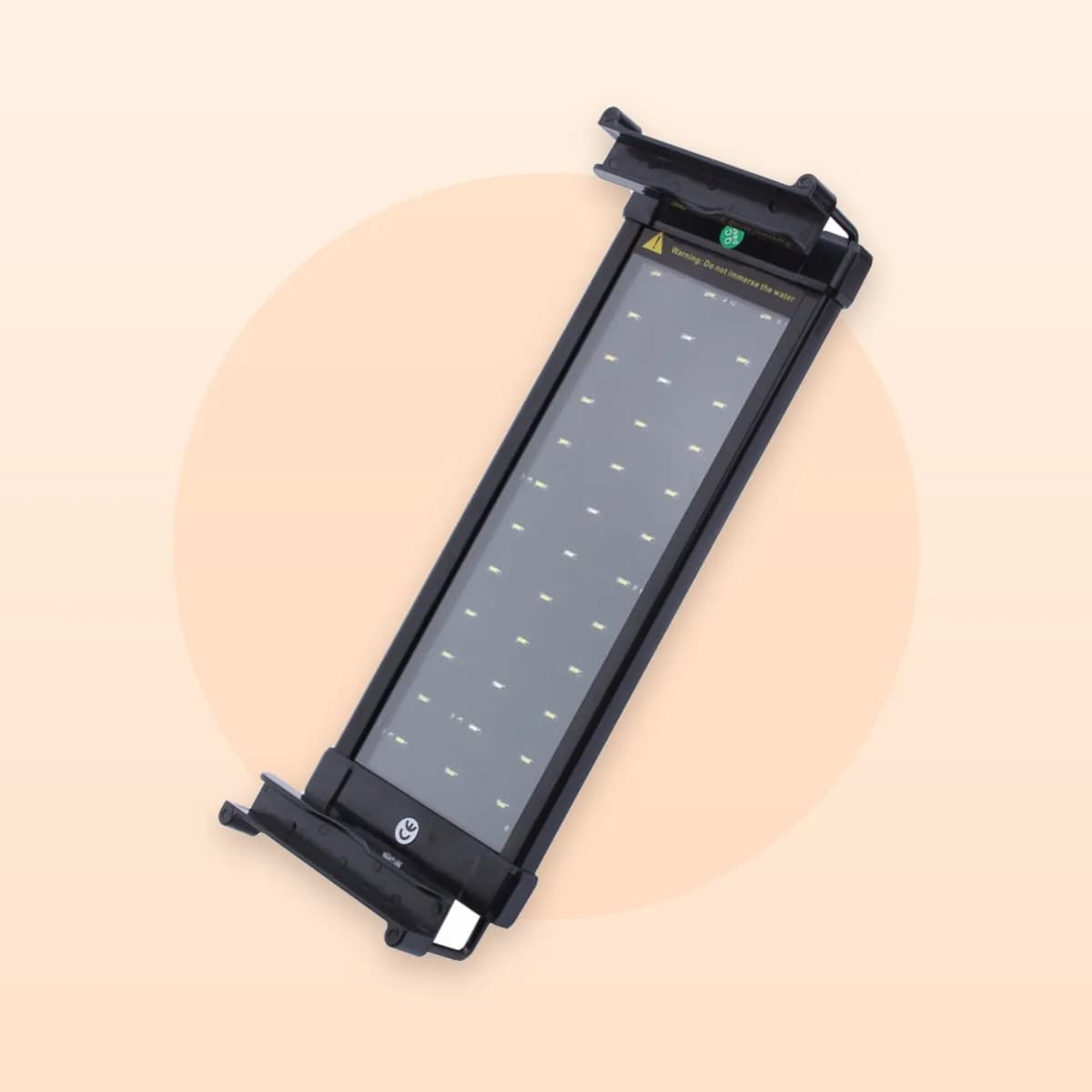
Light falls off quickly with depth, so a deep tank needs a stronger unit than a shallow one of the same footprint. A bar with telescopic brackets is worth having because it adjusts to the tank width rather than committing you to one size, which matters if you are likely to upgrade. Position it centrally along the tank so the front glass and the back corners get roughly even coverage.
Colour temperature affects appearance more than plant health in a freshwater tank. Something around 6500K reads as natural daylight and makes greens look green rather than yellow. RGB accent pods are decoration: they add colour behind rocks or into a corner and do nothing for plants, so treat them as a supplement to a main light rather than a replacement.
Safety around water
Every cable running to the tank should hang in a loop below the socket so water travelling along the cable drips off rather than reaching the plug. Keep the transformer above the water line, and check the seals on any light rated for splashes rather than immersion. A light that sits on a glass cover lasts longer than one exposed to the evaporation coming off an open tank.
Common questions
Six to eight, on a timer, at the same time every day. Longer favours algae. If plants look weak, increase intensity rather than extending the hours.
No, and they need genuine darkness to rest. A blue night light is for your benefit rather than theirs; if you run one, keep it dim and consider turning it off overnight.
Not by itself. Algae takes hold when light outruns whatever else is limiting growth, usually nutrients or carbon dioxide. Duration and direct sunlight cause far more algae problems than intensity does.
It is not advisable. Household fittings are not built for constant humidity, the spread is wrong for a tank, and the colour rendering flatters neither fish nor plants. The safety case alone is worth the difference.
Last reviewed 30 August 2026