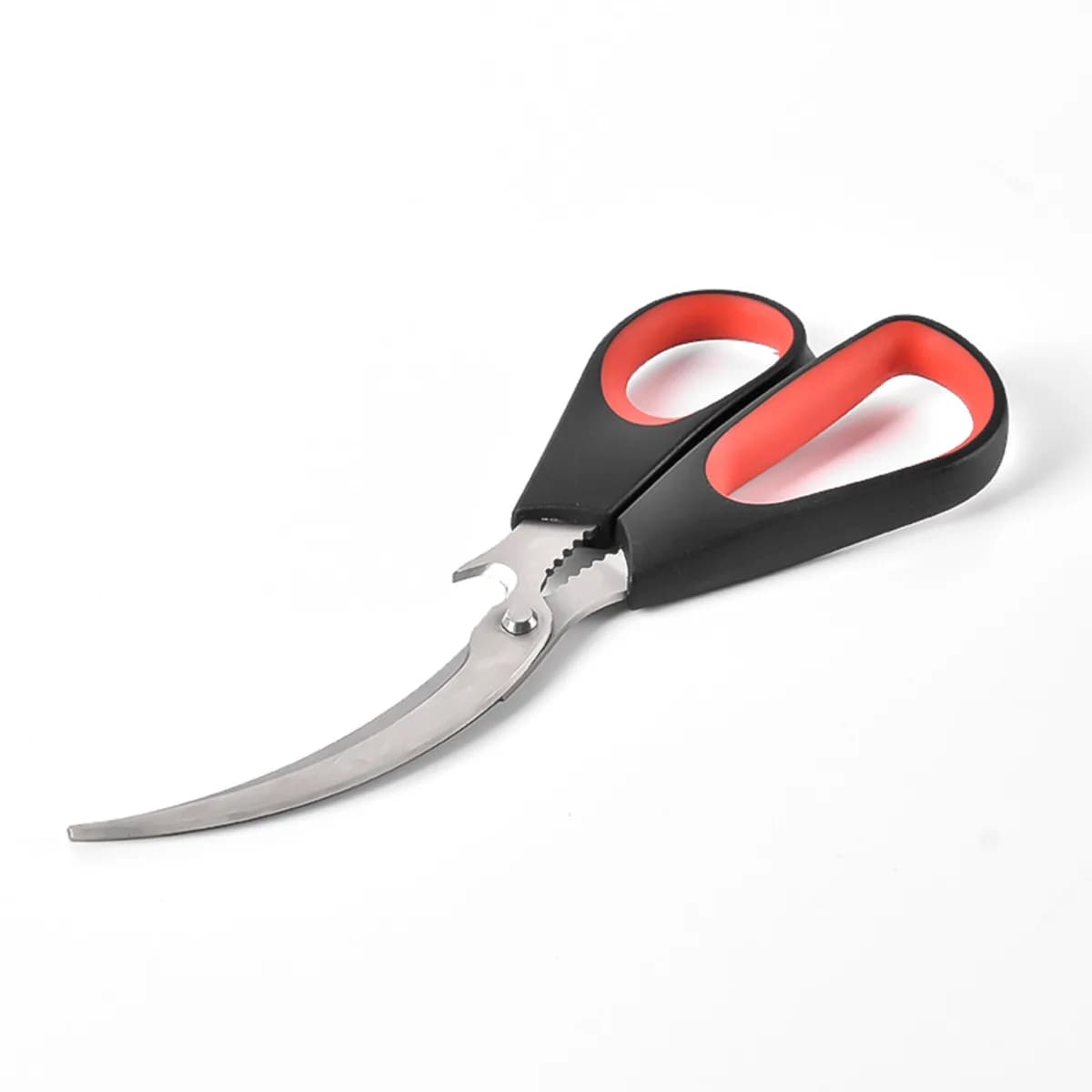
A crab leg is a tube. Straight kitchen scissors pinch it flat; these curved blades slide inside and follow the shell, so you split it lengthways and lift the meat out whole.
Colour Red
1
Free UK deliveryover £45
30-dayfree returns
Securecheckout
Long curved blades
Toothed jaws grip shells
Stainless steel and PP
About 21.5 cm long
Curved Seafood Scissors
Red
How to use it
Open the shell, keep the meat
01
Slide the tip under the shell
Start at the open end of a crab leg or lobster tail and push the curved lower blade inside.
02
Cut along the curve
Close the blades in short snips. The curve follows the shell, so the meat comes out in one piece.
03
Wash and dry straight away
Rinse off the shell and juices, then dry the blades and the pivot before you put them away.
Close up
Why the blades bend
123
1
Curved blades
Both blades arc the same way. The lower one goes inside the shell and the curve keeps its tip off the meat.
2
Toothed jaws
Short teeth near the pivot grip a slippery shell and bite into the thicker sections close to the pivot, where the squeeze is strongest.
3
Two tone handles
Black PP with a red or grey inner grip. The lower loop is long, so your fingers share the squeeze.
Compared
Scissors or a cracker?
A nutcracker style crab cracker breaks shell by crushing it, which is quick on claws and messy on legs. The two work well together on a whole crab.
Compared
This productSeafood scissors
Shell cracker
Kitchen scissors
Crab legs
Split cleanly
Crushed
Pinched flat
Lobster tail
Yes
Awkward
Hard going
Thick claws
Trim after cracking
Yes
No
Prawn shells
Yes
No
Yes
Questions
They are made for legs, tails and prawn shells. The thickest part of a large crab claw is better cracked first, then trimmed with the scissors.
The supplier doesn't say, so wash them by hand and dry them straight away, paying attention to the pivot where water collects.
Turn the tail shell side down, push the lower blade under the soft underside at the wide end and cut down the middle to the fan. Pull the two halves apart and the meat lifts out.
They trim herbs and snip bacon well enough, but the curve makes straight cuts on paper or packaging awkward. Keep them mainly for shellfish and they stay sharp longer.
Sharp items ship on a restricted courier route, so allow a little longer than for our other tools. Tracking is sent as soon as they leave the warehouse.
Reviews
4.8
91 reviews
Sample, not real
Filter
Keisha M.
2 Oct 2026
Sample, not real
Good, big claws need cracking first
Excellent on legs and tails. On a large crab claw I did have to crack it first and then trim, which the listing does say. So not a tool for everything, but great at what it's for.
I cook a lot of shellfish and have tried a few pairs of kitchen scissors. The curve on these is what makes the difference, it follows the leg so you can open it without crushing what's inside. Toothed jaws near the pivot are good for gripping slippery shells. They're not meant for the thickest part of a big claw, and I crack those first, as the listing suggests.
Took me a couple of tries to find the right angle on crab legs, you want the lower blade tucked inside the shell and short snips. After that it was smooth. Now it's a regular on seafood nights.