Cats
Do Cats Really Need a Water Fountain?
Cats are bad at drinking. That's not a quirk, it's a desert ancestry problem, and it shows up later as kidney and bladder disease.
6 min read
Sits at the angle their neck actually wants.
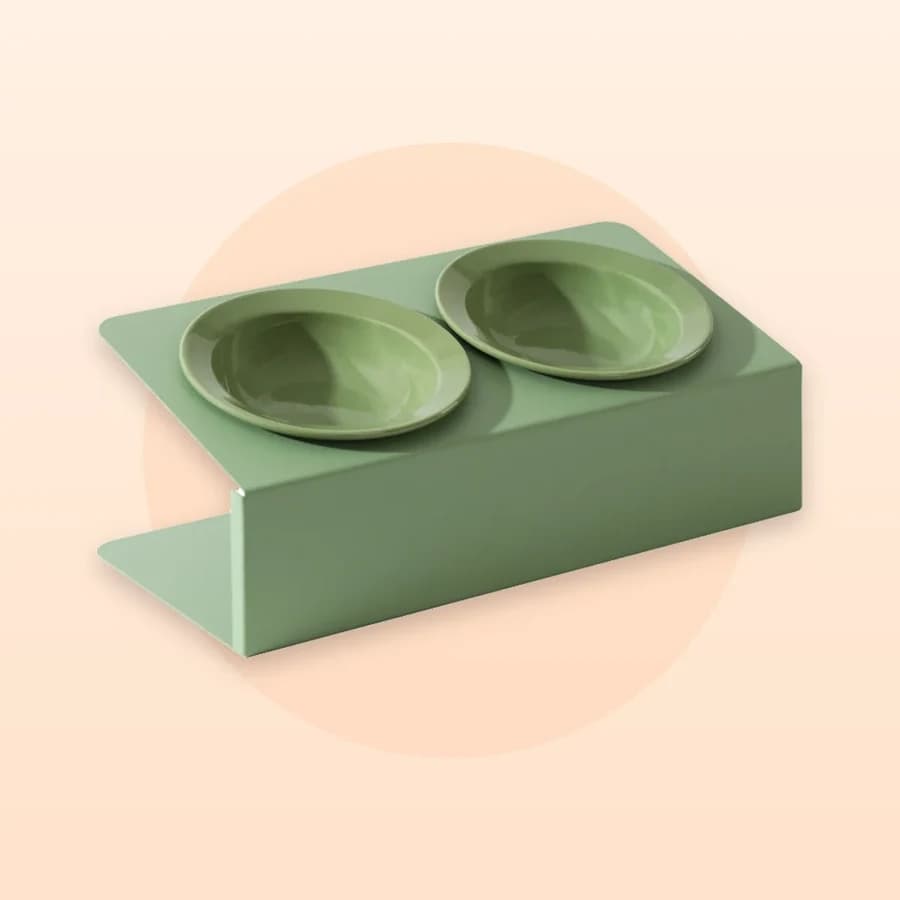
A single heavy bowl that solves two problems at once: the raised foot lifts it off the floor, and the tilted mouth angles the contents towards the animal so nothing gathers out of easy reach.
Taxes calculated at checkout
Design: Cow
Why you'll love it
A flat bowl on the floor makes a cat or short-legged dog bend their neck down and under. Raising and tilting it brings the food to a comfortable angle, which matters most for older pets and flat-faced breeds.
Plastic scratches, and those scratches hold bacteria and old food smells. A glazed ceramic surface has nothing for either to sit in, and it goes in the dishwasher.
Light bowls get pushed around the kitchen until the food is on the floor. A kilo of ceramic stays where you set it down.
Good fit if
Look elsewhere if
Eating from ground level means holding the head low and the neck extended for as long as the meal takes. For a healthy young animal that is unremarkable. For one carrying any stiffness through the neck, shoulders or front legs, it becomes the reason a meal gets abandoned part way through, and owners usually read that as a change in appetite rather than a change in comfort.
Raising the bowl a few centimetres brings the head closer to level. Combined with the tilted mouth, the animal reaches food without dropping into the low crouch a flat floor bowl forces. It is a modest change that shows up most clearly in older cats, who tend to eat more of the portion and leave less behind.
At around a kilogram this bowl does not move. That sounds trivial and is the single most common complaint about cheaper alternatives, because a bowl that skates across tile turns every meal into a slow pursuit around the kitchen. An animal chasing a moving dish also tends to eat faster and less carefully than one eating from something stationary.
The mass comes from solid glazed ceramic rather than a weighted base bonded to plastic, which matters over time. Bonded bases separate eventually, usually after enough dishwasher cycles to loosen the adhesive, and once they do the bowl is lighter than the one it replaced.
Glazed ceramic is non-porous, so nothing soaks in and nothing lingers as a smell after wet food. Plastic behaves differently: it scratches with ordinary use, the scratches trap residue that washing does not clear, and in cats that is a well-recognised trigger for the crop of small black spots under the chin known as feline chin acne. Switching bowl material is often the whole treatment.
The trade-off with ceramic is that it chips. Check the rim and the inside occasionally, particularly if the bowl lives on a hard floor, because a chip exposes the porous body under the glaze and that surface cannot be properly cleaned. A chipped bowl is worth retiring rather than working around.
In the box
How it works
Shop by pet or category to find exactly what your cat or dog needs, no wading through thousands of listings.
Check out securely with card, PayPal or one-tap Apple Pay & Google Pay. Free delivery over £45.
Fast, tracked dispatch straight to your door, and a happier pet before you know it.
The details
Good questions
It holds about 350g of dry food, which suits cats and small to medium dogs. A large breed eating a full meal in one sitting will want something bigger.
It is ceramic, so a hard knock onto a tiled floor can chip it like any bowl. It is fine in normal use on the floor, but it is not the one to take camping.
It can, like any ceramic, usually from being knocked against a hard floor or another bowl in the dishwasher. Check the rim occasionally and retire it if you find a chip, since the exposed ceramic underneath cannot be cleaned properly.
It suits small and toy breeds. At 350 g of dry food or a litre of water it is undersized for a medium or large dog, which will empty it in one sitting.
Yes, and the glaze is easier to clean afterwards than plastic. Wash it after each wet meal rather than topping it up, because dried residue around the tilt is what starts a bowl smelling.
Last reviewed 30 August 2026
Advice
Cats are bad at drinking. That's not a quirk, it's a desert ancestry problem, and it shows up later as kidney and bladder disease.
6 min read