How Often Should You Change Cat Litter? A Real Schedule

Ask five cat owners and you'll get five answers, ranging from 'every day' to 'when it gets bad'. Both are wrong, in different directions. The daily-full-change camp is throwing away usable litter and unsettling the cat; the other camp is why their hallway smells.
Here's what the schedule actually depends on.
The schedule by litter type
| Litter type | Scoop | Top up | Full strip & wash |
|---|---|---|---|
| Clumping clay (bentonite) | Twice daily | Weekly | Every 2–4 weeks |
| Non-clumping clay | Solids twice daily | n/a | Weekly, firmly |
| Silica crystal | Solids daily, stir weekly | n/a | Every 3–4 weeks |
| Wood pellet | Solids daily, sift sawdust | Weekly | Every 3–4 weeks |
| Paper / recycled | Twice daily | Every 2–3 days | Weekly |
The single figure worth memorising: two scoops a day. Morning and evening. That one habit does more for smell control than any change of litter brand, and it lets clumping clay go a fortnight or more between full strips without anyone noticing.
How deep should the litter be?
Three to four centimetres for clumping, five to seven for non-clumping. Too shallow and urine reaches the tray floor, which is where stubborn smell comes from and why some trays never smell clean again. Too deep and most cats will simply dig less thoroughly, which defeats the point.
Cats bury for a reason, and a tray they can't dig properly in is a tray they'll start avoiding. Avoidance usually shows up first as a cat perching on the rim rather than standing in the litter.
How many trays do you actually need?
The rule most behaviourists use is one per cat plus one. Two cats, three trays. It sounds excessive in a flat, and it's the change that resolves more litter-box problems than anything else on this page.
Cats are territorial about elimination and many won't use a tray another cat has just used. In a one-tray household with two cats, the lower-ranking cat frequently starts going behind the sofa. That reads as a behaviour problem. It's a resource problem.
Spread them out, too. Three trays in a row in one bathroom is functionally one tray with three compartments.
Why it still smells after a fresh change
If you strip the tray, wash it, refill it, and the room smells wrong within two days, the schedule isn't the variable. Work through these in order:
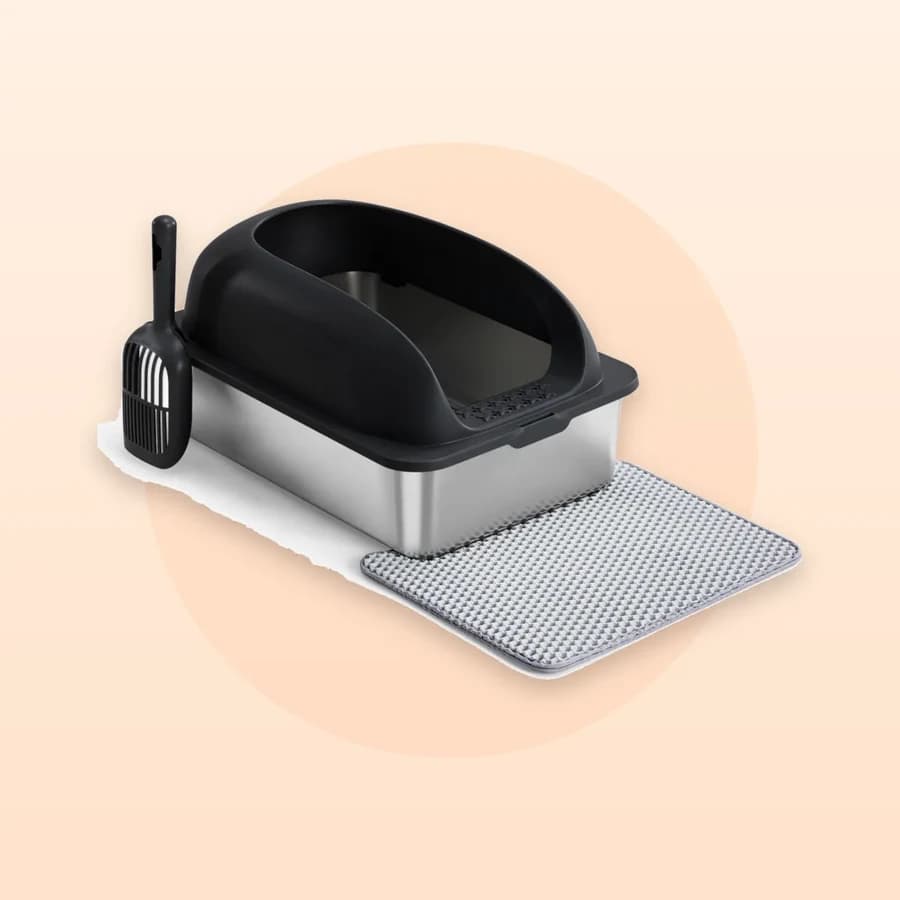
- 1The tray is scratched. Plastic scores over time and urine gets into the scratches, where nothing you scoop can reach. Plastic trays are consumables. Replace them every year or so, or move to stainless steel, which doesn't score.
- 2It's covered and under-ventilated. Hoods trap odour for you and concentrate it for the cat. Plenty of cats dislike them for exactly that reason.
- 3You're washing it with something scented. Strong cleaners, especially anything citrus or ammonia-based, drive cats off the tray. Hot water and unscented washing-up liquid is the whole method.
- 4The litter is too shallow, so urine is hitting the base.
- 5It's in a bad spot. Next to a washing machine that starts a spin cycle mid-visit teaches a cat to go elsewhere, quickly.
Changing litter type without a protest
Cats form a texture preference early and most dislike an abrupt swap. Mix roughly a quarter of the new litter into the old, hold for a few days, then go half, then three-quarters. Two weeks end to end.
If you have the space, the easier version is to put a second tray down with the new litter alongside the existing one and let the cat pick. Cats tend to vote clearly, and you skip the argument.
What about the mess outside the tray?
Tracking is mostly a litter-particle-size problem. Fine-grained clumping clay tracks the most because it sticks between the toe pads; larger crystal and pellet litters track far less. A mat with a raised texture catches a good proportion of what does come out, and matters most directly outside a high-sided or top-entry tray.
Get the scooping habit right and everything else on this page becomes optional tuning. Twice a day, sixty seconds a go.
Common questions
Every 2–4 weeks for clumping clay if you scoop twice daily, weekly for non-clumping clay, and every 3–4 weeks for crystal or wood pellet. Scooping frequency matters far more than the full-change interval.
A full change every day wastes usable litter and removes the familiar scent cues cats rely on to recognise the tray as theirs. Some cats become unsettled by it. Scoop daily and strip on the schedule for your litter type instead.
Three, placed in different parts of the home. One per cat plus a spare. Cats often refuse a tray another cat has just used, and under-provision is the most common cause of going outside the box.
Usually a scratched plastic tray holding urine in the scoring, litter that's too shallow so urine reaches the base, or a scented cleaner. Replace worn plastic trays yearly, keep clumping litter 3–4 cm deep, and wash with unscented washing-up liquid only.
Sources
We’re a retailer, not a veterinary practice. Anything clinical on this page comes from these, and your own vet knows your animal.

The Kindral Team
Pet supplies buyers & product testers
We buy, unbox and use the kit we sell: beds, feeders, tanks, harnesses, the lot. We write about what holds up and what doesn't, and we say plainly when a product isn't right for a particular pet. We are not veterinarians: anything touching health, diet or medication is sourced to a qualified body and linked, and we'll always tell you to ask your own vet about your own animal.