Danielle
4 Oct 2026
Gingerbread house that stands
Gingerbread house walls need to be the same thickness or the roof slides off. Used the 6 mm rings this year and the house actually stayed up through New Year.
Helpful?
ReportFree shipping on first order, code: WELCOME.
Rolls dough to a set 2, 3, 6 or 10 mm, so you stop checking it by eye.
Fit a pair of rings to the ends and roll until they touch the worktop. The dough underneath is then the same thickness all the way across, so biscuits bake evenly and pastry has no thin spot to tear.
Delivers only to Austria, Denmark, France, Germany, Iceland, Netherlands, Norway, Poland, Portugal, Romania, Spain, Sweden and Switzerland.
Free shipping on your first order with code WELCOME

Stainless Steel Bench Scraper
Cut and lift the sheet once it's rolled. €13.99
Rolling pastry
Rolled by eye, a sheet has thick and thin patches. Rings at both ends hold the barrel at one height, so every piece cut from it bakes alike.
A plain pin and a good eye
With the adjustable pin
How the rings work
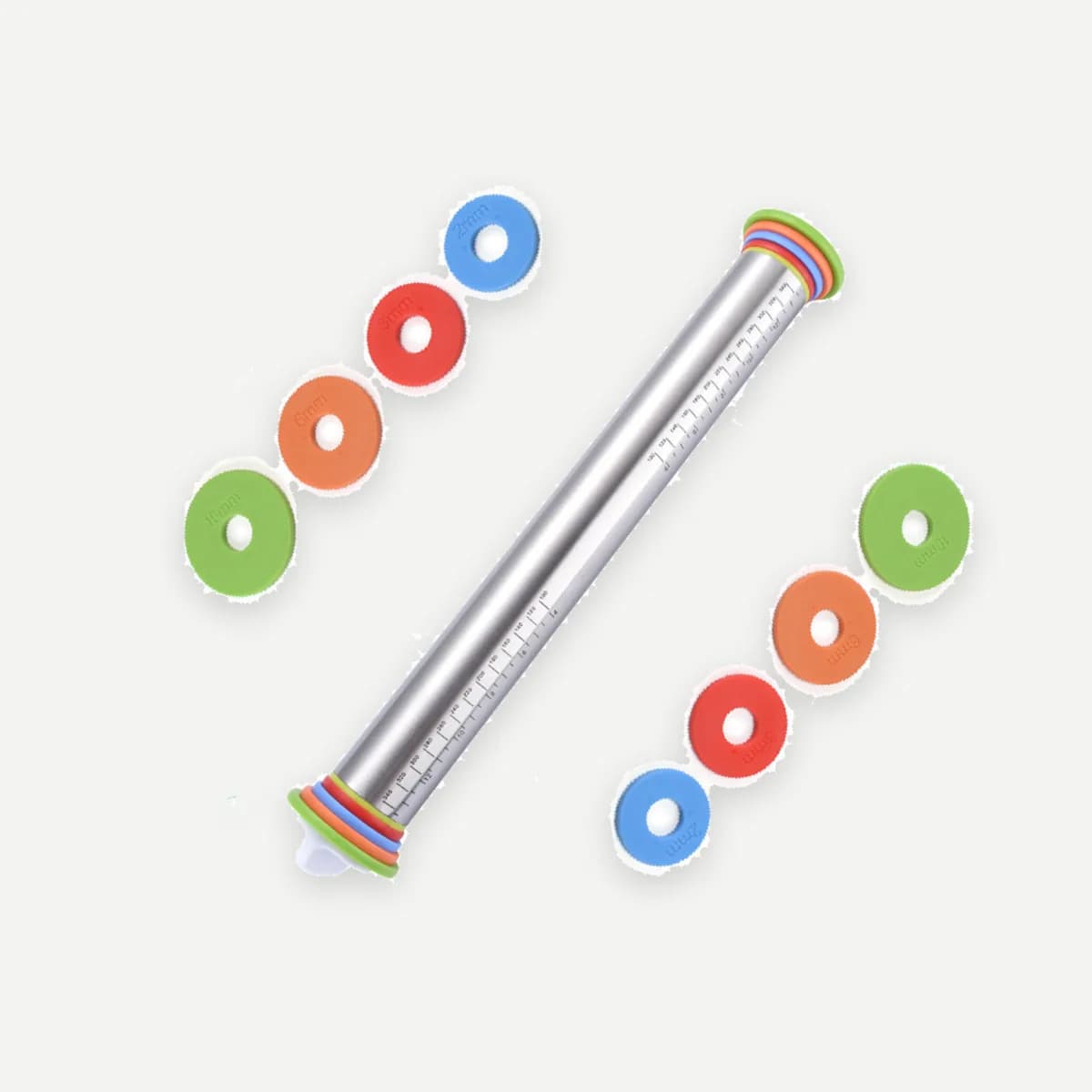
The steel barrel is 45 mm across. Every ring is wider, so it holds the barrel off the worktop by half the difference, and that gap is the depth of your dough.
They ride on the surface beside the sheet, so the barrel can't sink lower than they allow.
Rings of 49, 51, 57 and 65 mm on a 45 mm barrel leave 2, 3, 6 and 10 mm beneath the steel.
Once both rings touch down, more rolling spreads the sheet wider instead of thinner.


How to use it
Unscrew one end cap, slide a ring of the same size onto each end, and screw the cap back on.
Roll out from the middle. When both rings touch the worktop, the dough under the barrel is that thickness.
Read the scale on the barrel to see how wide the sheet is before you cut or lift it.
Pick the rings
The blue 2 mm pair, for sheets you want thin and level.
Red rings, 3 mm, for a pie lid or icing to drape over a cake.
Orange rings give 6 mm, so a tray of biscuits bakes at one pace.
Green rings lift the barrel 10 mm for doughs that need height.
Close up

Four pairs, colour coded by depth: green lifts the barrel 10 mm, orange 6 mm, red 3 mm and blue 2 mm.
Marks run along the steel, so you can roll a sheet to the width a recipe or a tin asks for.
One at each end. Unscrew a cap to swap rings, and always fit the same size at both ends or the sheet will slope.
Compared
A plain pin works if you have a good eye. Rings take the guessing out of it and travel with the pin, while loose guide strips have to be laid either side of the dough every time.
| Compared | This productAdjustable pin | Plain wooden pin | Pin and guide strips |
|---|---|---|---|
| Sets the thickness | Yes | No | Yes |
| Thickness choices | 2, 3, 6 and 10 mm | By eye | One per pair of strips |
| Pieces to keep | Pin and rings | Pin | Pin and strips |
| Cleaning | Wipe and dry | Wipe, never soak | Wipe each strip |
After baking
Unscrew a cap, slide the rings away and wash them on their own, so no flour stays trapped behind them.
Scrape off stuck dough, then go over the steel with a damp cloth. No soaking.
Towel it dry rather than leaving it on the drainer, because 430 steel can spot.
Try it at home
Tracked delivery across Europe, usually 8 to 15 business days. Free on orders over €59, otherwise €4.99. EU prices include VAT, so there's nothing to pay on arrival. If it isn't right for your kitchen, tell us within 30 days and we'll arrange a free return.
2 or 3 mm for pasta sheets, crackers and thin pastry, 6 mm for biscuits and a tart case, 10 mm for scones and thick cookies.
Yes. Take the rings off and it works as a plain 44 cm straight pin for anything where the thickness doesn't matter.
44 cm from end to end. The steel barrel is 35 cm long and 4.5 cm across, so it rolls a sheet up to about 35 cm wide in one pass.
It needs a light dusting of flour, as wood does. Chilled dough sticks less. For very soft dough, roll it between two sheets of baking paper with the rings still fitted.
Yes. Dust the worktop with icing sugar or cornflour and fit the 2 or 3 mm rings, which suit covering a cake or cutting shapes.
No. Once both rings rest on the worktop, the barrel can't go any lower, so the dough beneath it is the depth of the pair you fitted.
4.6
50 reviews
Danielle
4 Oct 2026
Gingerbread house walls need to be the same thickness or the roof slides off. Used the 6 mm rings this year and the house actually stayed up through New Year.
Jade
4 Oct 2026
Kept rolling with the rings on but the dough spread wider than the barrel, so the edges ended up thinner than the middle anyway. Probably my technique, but I've gone back to my old pin.
Sandy
4 Oct 2026
Made a quiche with a homemade crust on a Tuesday. Crust rolled in a minute, even thickness, no soggy bottom or burnt edge.
Austin G.
4 Oct 2026
Great pin, great results.
Wei N.
4 Oct 2026
The idea is great and the cookies came out even. My issue is the caps. One of mine is stiff to unscrew, so switching between the 3 and 6 mm rings halfway through a baking session means wrestling with it with floury hands. If you pick one thickness and leave it, you'll probably love it. I switch a lot so it's just okay for me.
Paige C.
4 Oct 2026
Way too long for my tiny kitchen. Gave it to my mom.
Aisha Patel
4 Oct 2026
Rolled pizza dough with the 3 mm rings for a thin crispy base. Every pizza came out even, no thick middle and floppy edge.
Luis M.
4 Oct 2026
Had to learn to roll from the middle outwards so the rings touch the counter. After that, great results.
Grace
4 Oct 2026
My galley kitchen has about half a metre of clear worktop and this pin takes up most of it, so I end up rolling at an angle. The pastry is even though.
Kim M.
4 Oct 2026
Even dough every single time. Very happy.
Showing 10 of 50